Higashimatsuyama, Saitama, Japan (Oct. 31, 2025): HREM Research Inc. announced that qHolo has been released in its definitive form. The software qHolo is a powerful plug-in for DigitalMicrograph that reconstructs and displays the quantitative information from off-axis electron holograms.
qHolo provides all the tools you need to carry out off-line quantitative analysis of electron holograms. In particular, qHolo was designed for the analysis of magnetic and electric fields at the nanoscale. qHolo works seamlessly with another holography plug-in from the HREM Research, HoloLive, which helps holography experiments by reconstructing the phase in real time. Both HoloLive and qHolo were jointly developed with CEMES-CNRS, Toulouse, France.
“Electron holography is the best method to measure the phase change by a specimen and measuring local fields,” says Kazuo Ishizuka, President of HREM Research Inc. “However, a hologram is not interpretable by eye as the phase change is encoded in subtle shifts of the holographic fringes.” Dr. Martin Hytch of CEMES says, “These days, we cannot imagine doing in-situ holography without HoloLive and analyzing the data with qHolo. You can imagine how difficult to see an effect introduced by applying a bias from the hologram fringes. Once the conditions have been optimized, we can acquire the best quality holograms and analyze them with qHolo.”
About HREM Research Inc.
Founded in 2001, HREM Research Inc. specializes in developing products and services for Quantitative Electron Microscopy. The company’s flagship product is xHREM, HR-(S)TEM image simulation suite, developed by the founder, Kazuo Ishizuka. Currently, HREM Research Inc. is actively working on making useful techniques to be available for the HREM community.
For more information, please visit https://www.hremresearch.com or contact support@hremresearch.com.
Contact:
Kazuo Ishizuka
HREM Research Inc.
14-48 Matsukazedai, Higashimatsuyama
355-0055 JAPAN
Supplementary materials
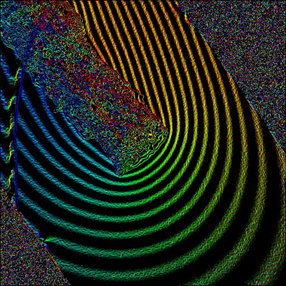
Colour coded illustration of the electric field around metallic nanowire supported by a holey carbon grid. The phase information is overlayed as cosine contours revealing the equipotential lines and the electric field direction by the colours.